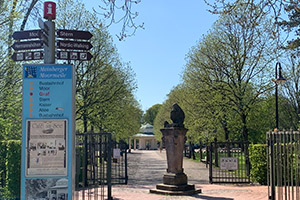
With its sulphurous moor, carbonic acid and healing water springs, the Meinberg state spa has many natural remedies. The historic Kurpark, the Seekurpark and the Silvaticum state forest park invite you to enjoy nature.
Hot days are refreshed in the local outdoor pool. In the village center there is a small church, it is the only surviving half-timbered chapel in the Weserbergland and is a listed building. In addition to eggs and liqueur, the Straussenhof Möller also offers guided tours in its farm shop.
LWL-Freilichtmuseum Detmold
The extensive grounds with historic buildings are surrounded by beautiful nature. A visit to the open-air museum offers a nice day out with family or friends.
In the workshops you can watch the photographer, the blacksmith, the baker and the potter at work. Lots of old plant species and varieties can be discovered in the gardens, which were laid out according to historical models.
On the pastures and meadows you will also find old breeds of domestic animals that are threatened with extinction, such as the Senner horses, the Siegerland red cattle or the Lippe geese.
The Bollmühle (water mill) is a monument on the Silberbach in Veldrom. In addition, the Prussian Velmerstot offer about 464 m above sea level. NN. and the Lippe Velmerstot about 441m above sea level. NN a breathtaking view.
Feldrom/Kempen
In the tractor museum in Kempen there are 60 tractors from all over the world. It shows how agriculture developed from the Middle Ages to the 1960s. Horses are bred at Gut Kempen today.
Fissenknick Mühle
A visit to the extensively restored windmill from 1847 is worthwhile. It is a lookout tower and popular restaurant in a beautiful scenic location.
Fromhausen Lavendelfeld
Photo: Werner Wilmes
A sea of purple flowers awaits you here. Here Taoais lavender fields bloom in the season from June to August. In addition to the sea of flowers, the Rosenhof-Lippe offers donkey hikes or donkey relaxation cuddle time and mobile home parking spaces.
Holzhausen-Externsteine
Holzhausen-Externsteine is a “state-recognized climatic health resort” and home to the legendary Externsteine. The small spa park invites you to linger and relax. The peace and quiet is particularly noticeable as the place has no through traffic
Heesten Historische Warte
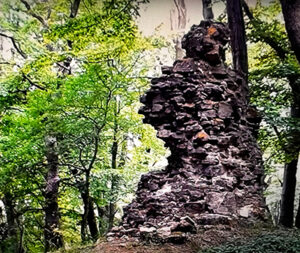
The historic watchtower on the Ziegenberg, a ruined tower in the middle of the forest, was built in 1442. The FFH protection area "Silberbachtal mit Ziegenberg" is not far away. On the manor Küterbrok, in addition to holidays and pony rides, cuddling with cows is also very popular.
From here it goes downhill to the next fork in the road. Once there, we come across the "Bäderweg" and walk parallel to it for a while through an old ravine, then along the edge of the forest until we get back to the starting point. In the last few meters we still enjoy the view of the village of Leopoldstal and with a keen eye we can see the Eggeturm on the Prussian Velmerstot in the distance.
Directions The rest is a hiking trail !!
Adlerwarte
The eagle observatory in the Detmold district of Berlebeck houses more than 200 birds of prey from all over the world: bald eagles, lanner and saker falcons. Clean men of nature, black and griffon vultures, native kites and buzzards.
In order to be able to experience the fascinating birds of prey up close, the eagle observatory regularly offers free flight shows on the panorama terrace with a view of the Teutoburg Forest.
Opening hours:
Early March to early November daily from 9:30 a.m. to 5:30 p.m
Offers:
Free flight show: early March to early November: 11 a.m. and 3 p.m from May 1st to November 1st also at 1 p.m Saturdays, Sundays, public holidays and during the NRW holidays also at 4:30 p.m
A privately run bird park of a special kind with over 1,200 birds and 300 species of mammals. Pelicans, storks, cranes, peacocks and rare hornbills, monkeys, prairie dogs and kangaroos can be admired here.
In addition to a petting meadow, there is also an adventure playground for the children and small snacks.
Opening hours:
March to November, daily 9 a.m. to 6 p.m
at 12.00 and 16.00: feeding of the baby parrots;
at 3 p.m.: Participation in feeding with the animal keeper possible
A castle in the style of the Weser Renaissance. The castle is owned by the family of Dr. Armin Prinz zur Lippe, a relative of the Dutch royal family. Parts of the castle are open to visitors. Extensive collections of porcelain, historical weapons and paintings can be found here.
Opening hours:
daily from 10 a.m. to 4 p.m.; April to October: daily until 5 p.m
Information about the tours:
German, English, French or Dutch; during opening hours, on the hour and by appointment; Duration of the tour: 40 to 45 minutes
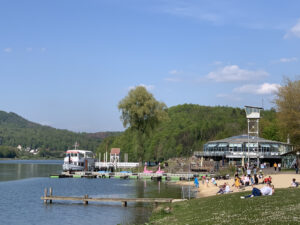
Not far from Horn-Bad Meinberg, the SchiederSee leisure center offers activities for young and old with a guaranteed fun factor. And if you like, you can explore the reservoir on a one-hour tour.
It is 496m high and thus the highest elevation in the Lipper Bergland.
An open-air cinema offers a breathtaking panoramic view of the Teutoburg Forest and the Weserbergland. 36 wooden cinema seats invite you to enjoy the wonderful "nature film".
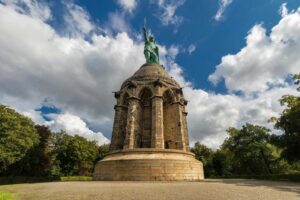
With a height of 60 m, the symbol of the Teutoburg Forest can be seen from afar because it towers over the entire region. The Hermann monument commemorates Arminius (Hermann), a prince of the Cherusci. Under his leadership, the Germans were able to crush the three Roman legions of Publius Quinctilius Varus in the Teutoburg Forest in 9 AD in the Varus Battle.
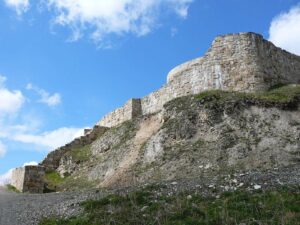
The Falkenburg is the former seat of the rulership of the Lippe. It was built around 1194 by Bernhard II zur Lippe and his son Hermann II. The ruins of this mediaeval hilltop castle with ring wall, keep, palace, outer bailey and kennel can be experienced on your own or as part of a guided tour. Guided tours are possible from the beginning of May to the end of October.
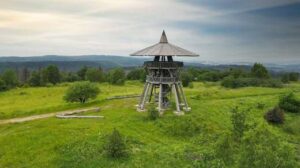
The striking wooden construction with the "mushroom head" marks an area steeped in history. The (or the) Velmerstot used to mark the border between the Lippe and Prussia, which is why the two hilltops are still differentiated according to "Lippian" and "Prussian".
In 2003, the Paderborn Forestry Office erected the 17-metre-high tower on the 468-metre-high Egge summit (Prussian Velmerstot). In 2010, the "mushroom head" was added to the tower to better protect it from the harsh weather.
The viewing platform at a height of 9 meters offers a breathtaking view of the Teutoburg Forest with the Hermann Monument and far beyond, over the ridges of the Egge, the northern Lippe highlands, the Schwalenberger Forest, the Weserbergland, the Köterberg, the Solling, the volcanic cone of the Desenberg, the Habichtswald and the Sauerland.
Between 1710 and 1711 silver was searched for in the Silberbach valley near the village of Leopoldstal, but the yield was only small.
However, the water power of the silvery shimmering Silberbach led to the settlement of various mills. In addition to three milling and four grinding mills, there were also two fulling mills in the upper reaches of the stream.
You can still find quarries on the slopes of the valley today, where Osningsandstein was mined as a sought-after building stone in the 14th century. The wild and romantic Silberbachtal is the ideal starting point for extensive hikes, for example to the Velmerstot with its twin peaks.
Silberbachtal Silbertachtal car park 32805 Horn-Bad Meinberg
Straussenhof Möller
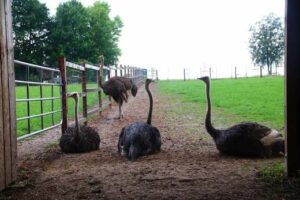
Manni and his friends live at Straussenhof Möller and they love to eat stones! Yes, you read that right! Ostriches eat rocks to grind up their food because they don't have teeth.
In addition to the guided tours offered, there is also a small farm shop, which is open every Saturday from 2 p.m. to 4 p.m. during the summer months.
The following products are produced on the farm:
Ostrich Eggs Ostrich decoration eggs ostrich feathers Ostrich Eggnog Fresh ostrich pasta From around August 2022 also ostrich meat Season times:
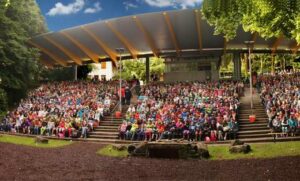
The Bellenberg open-air theater is located right on the edge of the forest and offers theater fun for young and old with around 850 seats. It looks back on a 70-year tradition.
The stage system resembles an amphitheater – the stage area and the audience benches form a circle. You can see and hear well from all numbered seats. Part of the area is even covered.
You can get tickets for the events here or on site at the Tourist Information.
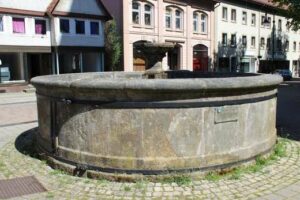
In the historic town center of Horn you can find evidence of the former water supply. On Mittelstrasse below the Horn town church you will come across the “Pfeifenkump”.
Even if it looks like it, it is not a well because there is no spring under the “Pipe Kump”. Rather, it was a stone water container that was supplied by a water pipe. In Low German, such systems, like portable water containers, were called “Kümpe”.
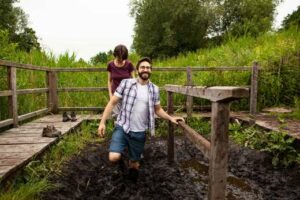
The history of Bad Meinberg is closely rooted in the healing sulphurous moor, which has been mined for therapy since 1820 on the edge of the state baths.
Moor is a very special habitat because it is an ecological transition zone between land and water. The memorable smell of sulfur - especially on warmer days - has given the Bad Meinberger Moor the name "Stinkebrink". The "black gold" vitalizes, regenerates and activates. It warms and caresses body and soul, produces soft skin that is clean down to the pores, muscles with good blood circulation and flexible joints. Certain ingredients are absorbed through the skin into the human organism and have an anti-inflammatory effect there with endogenous proteins. It is used, among other things, for rheumatic diseases, arthrosis, arthritis and osteoporosis.
Moor has also long been used for beauty care. The rejuvenating and supportive effect of moor packs was already known in ancient Egypt. Due to valuable organic ingredients, it has many good properties that can also have a positive effect on skin care and skin irritation.
Moor Stinkebrink On the heath 32805 Horn-Bad Meinberg
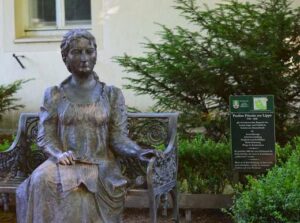
Pauline Christine Wilhelmine zur Lippe
Pauline Christine Wilhelmine zur Lippe (born Princess of Anhalt-Bernburg) is one of the most important people in Lippe's history. In 1796 she married Prince Leopold I of Lippe and, after his death, took over the regency of the Principality of Lippe on behalf of her underage son, Prince Leopold II. By meeting Napoleon Bonaparte, she prevented Lippe from being incorporated into the Kingdom of Westphalia, thereby preserving the independence of the principality.
However, her social commitment particularly stands out, because she founded the first day care center in Germany and devotedly took care of the poor and sick of the principality. When she was in Bad Meinberg for a cure, she granted audiences while she sat knitting on a bench in the historic spa gardens. Since 1995 you can see her bronze likeness in front of the Ballhaus during this activity.
Fürstin Pauline zur Lippe Parkstrasse 6 32805 Horn-Bad Meinberg
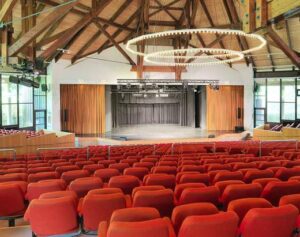
Kurtheater
The Bad Meinberg Kurtheater is located directly next to the Kurgastzentrum and not only nestles up visually with the rest of the building thanks to the deep construction, but also offers a lot of daylight through large window fronts along the tiers. Here you will find space for 698 people.
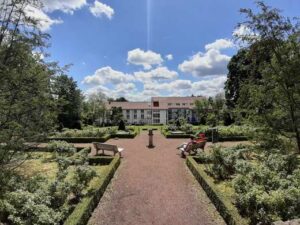
At the end of the 1950s, an expansion of the park facilities was considered in Bad Meinberg. The three existing ones – the historic spa gardens, the Seekurpark and the Bergkurgarten – were no longer sufficient due to the enormous increase in the number of spa guests.
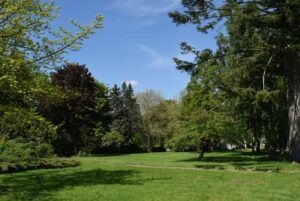
The state forester Dr. Arnold Splettschläger had the idea of creating a spa park that was completely new for Germany, a country forest park, arranged according to different landscapes of the world. The trees should be planted in a spacious green landscape. dr Splettschläger's goal was to collect as many foreign trees as possible in this park in order to demonstrate the compatibility and vitality of the various species in our region.
The required area of approx. 36 hectares was purchased from several local farmers by the Lippe Regional Association, which runs the Meinberg State Spa. In 1961 the construction of the path began and in 1962 thirteen forest landscapes, each approx. 1 ha in size, were created. Seven of the forest landscapes are located in Central and Southern Europe, four North American and two East Asian forest landscapes were also created. The later created fourteenth area comes from the Caucasus.
dr Splettschläger coined the term “Silvaticum”, derived from the Latin “silva” (forest), for the new state forest. The then horticultural department of the Meinberg State Spa and the forestry department of the Lippe Regional Association planted 36,000 trees and shrubs on an area of around 12 hectares. Meadows and paths were created on the remaining areas.
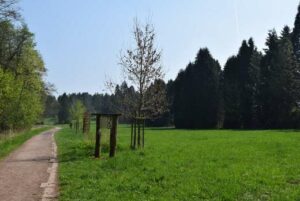
The paths of the Silvaticum are often used for relaxing walks and hikes.
State Forest Park Silvaticum Bad Meinberg wall path 32805 Horn-Bad Meinberg
Seekurpark Bad Meinberg
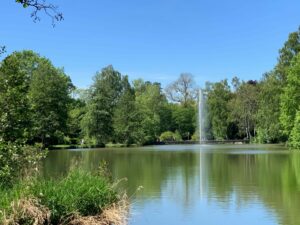
From 1952 to 1955, the Kurpark am See was laid out according to plans by Hermann Niemeyer. It can be reached from the historic Kurpark via plant beds with alternating planting. A 12 meter high fountain awaits the guest here from May to October from 9:00 to 11:00 and 15:00 to 17:00. In its place was previously the so-called water lily pond, which was quite swampy.
Seekurpark Bad Meinberg 32805 Horn-Bad Meinberg
Bergkurpark
Photo: Werner Wilmes
In 1932, the Bergkurpark was completed north of the historic Kurpark on an area of around 3 hectares between Stern and Schanzenberg. This terraced park is defined by its geometric design. Characteristic elements are the spacious central staircase and the natural stone walls with various rock garden plants. Rose beds, groups of shrubs and box break up this garden. The Garden of the Senses aims to stimulate the senses. The planning came from the garden architect Pieper from Bielefeld, with whom Hermann Niemeyer came to Bad Meinberg as executive garden manager.
Small but fine that is how the spa park in Holzhausen can be described. It has a rich stock of trees and bushes, with 36 species from 3 continents. Trees ranging from maple to cedar give this gem its special appeal. The highlights are the sequoia and the ginkgo. The Kurpark not only invites you to relax, but also to marvel. A breathtaking view, benches to relax and a place of rest and of course the fresh air.
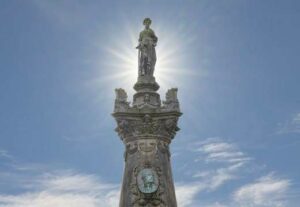
In the center of Horn's market square is the sandstone memorial to Franz Hausmann (1818-1877), member of the Lippe Landtag and Reichstag.
The convinced democrat Hausmann was not only legal counsel in his hometown of Horn, he was also vice-president of the constituent state parliament of Lippe and a member of the Reichstag of the North German Confederation. Franz Hausmann was a convinced democrat and a champion of bourgeois-democratic freedom rights.
The imposing monument has a size of 10 meters and a closer look reveals some imaginative details.
Franz Hausmann Monument marketplace 32805 Horn-Bad Meinberg